Prompt Loops: A Smarter Way for Charleston Businesses to Use AI
Stop chasing “perfect prompts.” Start using simple loops that turn AI into a real marketing partner for your Lowcountry business.
Why this “prompt loop” matters now
If you’re a Lowcountry business owner, you’ve probably tried AI the way most people do:
open ChatGPT, type one big request, skim the answer, and decide whether it’s “good enough.”
The problem isn’t the tool. It’s the expectation that one prompt should magically deliver a
finished campaign, blog post, or marketing plan.
Across the country, more and more small businesses are folding AI into their day-to-day work—
but the real advantage is shifting from “use AI once in a while” to “build repeatable loops
that get smarter every week.” For Charleston, where relationships and local nuance matter,
that shift is especially important.
From one‑off prompts to loops
- Single-shot prompts lead to generic, forgettable content.
- Prompt loops turn AI into a brainstorming and editing partner.
- Each loop adds more Charleston context—your customers, your streets, your reality.
The Prompt Loop Advantage
Most owners use what could be called “single‑shot prompting”:
- “Write a marketing plan for my Charleston restaurant.”
- “Draft Facebook posts for my Mount Pleasant spa.”
Then they judge AI on that one attempt. But the real power comes from prompting as a loop:
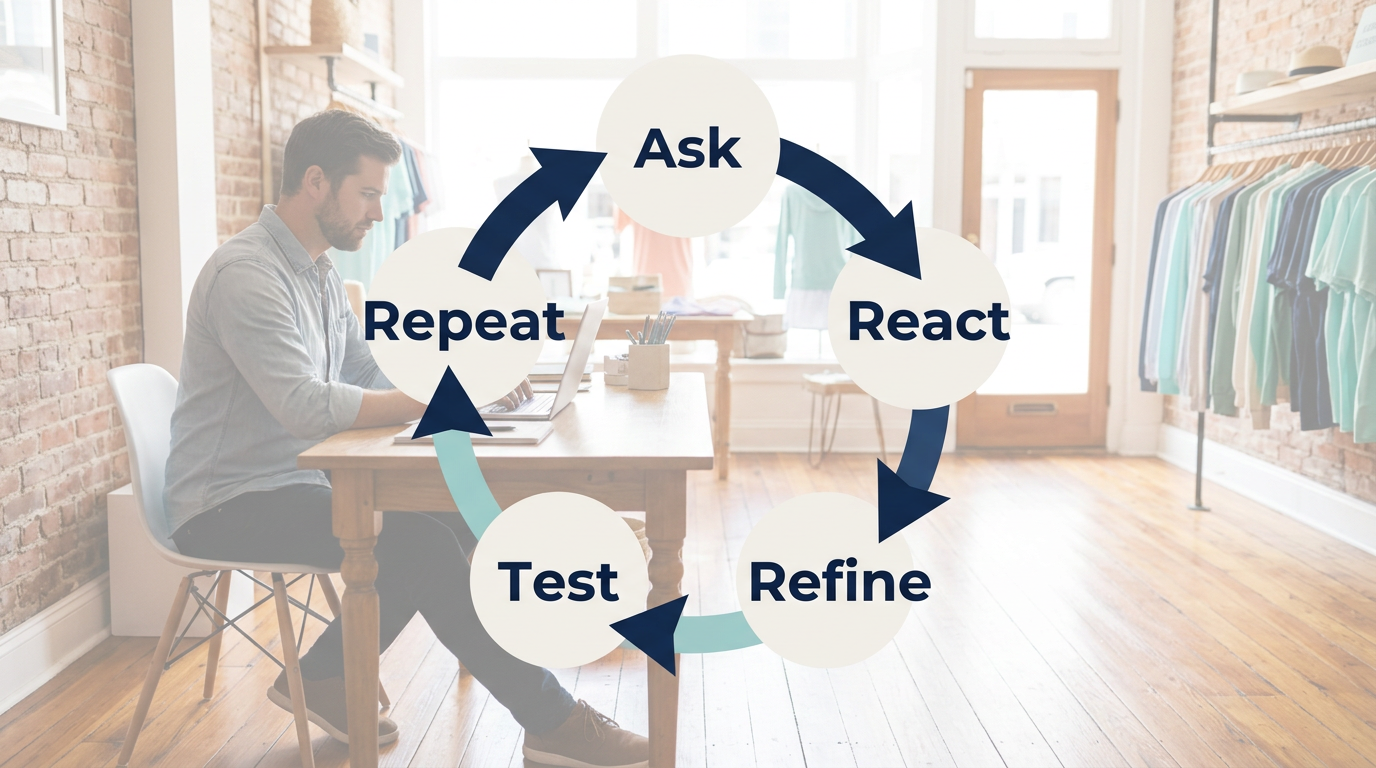
Ask → React → Refine → Test → Repeat
-
Ask: Start with a simple, directional request.
- “Give me 5 ways a neighborhood restaurant on James Island could increase Tuesday night traffic.”
-
React: Tell AI what feels on‑brand and what doesn’t.
- “Ideas 2 and 4 fit our vibe. Rewrite them to speak to busy parents in West Ashley and add realistic budget ranges.”
-
Refine: Feed it real numbers and constraints from your business.
- “We seat 60, average ticket is $28, kids’ meals are a strength, and we’re short‑staffed before 6 p.m. Adjust the ideas with that in mind.”
-
Test: Ask AI to stress‑test its own ideas.
- “Now, list what could go wrong with each idea in Charleston specifically (parking, weather, tourists, staffing) and how we’d adjust.”
-
Repeat: Take what worked and run a new loop for the next asset:
an email, a social post, a landing page, or even a script for a short Reels video.
Pro Tip
The “hack” isn’t a secret phrase; it’s expecting AI to improve through a back‑and‑forth
conversation, the same way you’d brief and coach an employee. The more you loop, the
more your content sounds like you—and like Charleston.
Why This Matters More in Charleston
Charleston is a relationship town. Prompt loops let you bake that relationship mindset into every AI conversation.
Local nuance, built in
- Traffic on the Ravenel Bridge and parking on King Street.
- Whether a business feels more “tourist‑y” or “locals know.”
- How your brand shows up for neighborhoods like West Ashley, Park Circle, or Summerville.
Examples of Charleston‑aware prompts
-
A King Street boutique: “Rewrite this email as if I’m texting my best downtown customer
who only shops when she’s already nearby for lunch, and mention walking distance from the Visitor Center.” -
A Summerville home services company: “Adjust this offer to be realistic for a three‑truck
team during peak pollen season and I‑26 traffic.” -
A West Ashley restaurant: “Create Q&A content around ‘Where’s a quiet Tuesday date spot
in West Ashley with parking?’ to show up better in AI‑driven search.”
Over time, your prompt loops become a way to teach AI who your customers are,
how they speak, and what life in the Charleston area is actually like.
Turning Prompt Loops into Real Marketing Outputs
Here are three everyday places to apply prompt loops in your next 90 days.
1. Campaign concepts and offers
- Round 1: “Give me 10 May campaign ideas a Charleston retailer could run to drive in‑store foot traffic.”
- Round 2: “Keep the 3 ideas that would photograph well in store and could be supported with a Post and Courier sponsored content package. Add rough timelines and necessary assets.”
2. Content built for AI search
AI‑driven “answer engines” sit between your customers and traditional search results, which
means generic keyword pages like “best restaurants Charleston” aren’t enough.
- Round 1: “List questions Charleston residents might ask an AI assistant before choosing a brunch spot.”
- Round 2: “Turn the best 5 into Q&A content for my website, referencing specific neighborhoods, occasions like bachelorette weekends, and parking or walkability.”
3. Creative for social and SMS
Local businesses that mix AI with email and SMS are seeing stronger engagement than those relying only on social algorithms.
- Round 1: “Write 5 SMS messages inviting VIP customers to a last‑minute in‑store event on King Street this Saturday afternoon.”
- Round 2: “Shorten each to under 140 characters, make them feel like a personal invite from the owner, and include a clear call‑to‑action.”
From one idea to many assets
From there, a quick extra loop can turn the same idea into a Reel script, a print ad headline,
and a sponsored content hook that all feel consistent but are tailored to each channel.
Where Charleston Businesses Go Next
Nationally, small businesses using AI report stronger efficiency and revenue gains—especially
when they plug it into marketing and customer communication instead of treating it as a side project.
Locally, Charleston brands that combine AI with strong first‑party data, simple automation, and
trusted platforms like The Post and Courier are already starting to pull ahead.
For Charleston owners, the next step isn’t “Should I be using AI?” The better question is:
“How can I build simple loops into what my team already does every week?”
A single well‑designed loop around your email list, social content, or in‑store events can be
enough to feel the difference in the next quarter.
If you think about your own marketing right now, what’s one recurring task—emails, social posts,
campaign ideas, or something else—that would be easiest to turn into your first consistent AI prompt loop?