AI In Advertising

AI in Advertising: What’s Legal, What’s Risky, and What to Do Now

The Big Idea

AI in Advertising: What’s Working, What Needs a Lawyer, and What to Stop Now
A practical legal and strategy guide for Lowcountry marketers using AI in ad creation — May 2026.

12+
FTC “Operation AI Comply”
enforcement actions since 2024

June ’26
New York’s AI synthetic performer
disclosure law takes effect

$0
Copyright protection for purely
AI-generated ads — you may not own it

You
Hold the legal risk when AI tools
generate infringing ad content

AI has made it faster and cheaper than ever to create ads, visuals, copy, and campaigns. But the legal ground underneath it is shifting fast — and in 2026, “the AI made it” is no longer a defense. Lowcountry marketers who understand the rules will move faster. The ones who don’t will move backward.

Gaining Ground: AI Tools Earning Their Keep
✍️AI-Assisted Copy & Campaign Ideation

Using AI to generate first drafts of ad copy, email subject lines, social posts, and campaign concepts is low-risk and high-value — as long as a human reviews, edits, and directs. That human layer also matters legally: substantial human creative input is what makes AI-assisted work potentially copyrightable. Treat AI as a copywriter’s assistant, not a replacement. Edit meaningfully. The more human direction goes in, the stronger your ownership claim on the output.

Low risk, high value

🎯AI-Powered Audience Targeting & Personalization

Modern ad platforms — including what P&C offers through its first-party data stack — integrate AI to match messages to the right local households at the right moment. This is where the real ROI lives: not just generating content faster, but getting it in front of verified Lowcountry residents who actually match your buyer profile. Layer AI-driven personalization on top of trusted, first-party audience data rather than third-party cookie pools that are evaporating.

Strongest local edge

🖼️Licensed AI Image Platforms

Not all AI image tools carry the same risk. Platforms like Adobe Firefly and Getty’s AI generator are trained exclusively on licensed content, which significantly reduces copyright exposure for commercial use. If you’re generating visuals for ads, this distinction matters more than most marketers realize. Default to licensed-source AI image tools for anything running in paid media. Check platform indemnification terms before publishing commercially.

Safer for paid media

📊AI for Reporting & Campaign Analytics

Automated performance summaries, weekly metrics digests, and AI-written campaign recaps are well-established, lower-risk applications — and they reclaim real hours for your team every week. AI assembles the data story; a human makes the decisions. Build a standing workflow that pulls your key ad metrics weekly and drafts a plain-language summary. The FTC has no quarrel with internal efficiency tools.

Hours back every week

Holding Steady: Needs Guardrails, Not Elimination
⚖️AI-Generated Visuals in Ads — Own It or Risk It

Purely AI-generated images — no meaningful human editing — are not copyrightable under current U.S. Copyright Office standards. That means a competitor could use the same output. More critically, if your AI image resembles a protected work, a real person, or a trademarked character, you are holding the legal exposure — not the AI vendor. Always review AI-generated images for visual similarity to known brands, artists, or people before publishing. Add real human creative direction and editing — not just a prompt — to strengthen your ownership position. Document your process.

Document everything

🎙️AI-Generated Voices & Synthetic Performers

Voice cloning and synthetic spokespeople are powerful — and now specifically regulated. Starting June 2026, New York requires conspicuous disclosure when ads use AI-generated synthetic performers (digitally created humans that appear real). Violations carry civil penalties up to $5,000 per offense, with more states and federal action likely to follow. Get ahead of it: disclose AI-generated performers in your creative even in markets where it’s not yet legally required. In a relationship-driven market like Charleston, transparency is itself a competitive advantage.

Disclose now, not later

📋Vendor Terms & Indemnification — Read the Fine Print

Most AI platform terms push copyright and infringement risk back onto the user. If a rights holder sues over an AI-generated ad, the AI company is typically not your defense. Before you publish: Does your platform grant commercial rights to outputs? Does it cover paid media and broadcast? Does it indemnify you for copyright claims, or disclaim liability entirely? Build a simple intake log for any AI tool used in ad production — which platform, which plan, who wrote the prompts, where it will run. That documentation creates a defensible record if questions arise later.

You hold the risk

Losing Steam: Stop Doing These Now
🚫Claiming “Full AI Automation” Without Proof

The FTC’s enforcement pattern is clear: exaggerating what AI can do is a consumer protection violation. Operation AI Comply has targeted inflated capability claims, including a $48.6 million settlement over a company that promised “nearly 100%” automation when users had to do most tasks manually. If you’re advertising AI-powered services to clients or customers, apply the same standard you’d apply to any performance claim: have proof before you say it.

FTC enforcement target

🎨Mimicking Artists, Voices, or Recognizable Styles

“Inspired by” is not a legal standard. AI image generators trained on vast libraries can produce content that closely resembles protected works — and if that happens in your ad, the infringement exposure belongs to you, not the AI. Prompting a tool to generate something “in the style of” a known artist, or using a synthetic voice that sounds like a public figure, is a lawsuit waiting to happen in commercial advertising. Avoid it. Describe the aesthetic elements you want instead of referencing specific creators.

High litigation risk

🤖Publishing AI Content Without a Human Review Step

Every workflow that sends AI-generated content directly into the world — copy, images, claims, reviews — without a human checkpoint is a liability. The FTC has made clear there is no AI exemption from existing consumer protection laws, and AI-generated content that turns out to be false or misleading is still false and misleading. Always build a mandatory human review step into every AI content workflow, no exceptions.

No AI exemption exists

Local Example — Mount Pleasant

A Mount Pleasant home goods retailer wanted to cut production time on monthly email campaigns. They built a workflow using AI for first-draft copy layered onto P&C’s targeted email list to reach verified local homeowners. A human copywriter reviewed and localized every draft — checking accuracy and adding the brand voice AI alone couldn’t replicate. They used Adobe Firefly for lifestyle imagery (licensed source), documented their process, and disclosed AI use in internal production notes. Result: campaigns out in half the time, higher open rates from better audience targeting, and no legal exposure. The AI did the heavy lifting; the human kept the brand and the business protected.

AI Ad Use Case — Risk at a Glance
AI Use Case Risk Level Key Safeguard
Copy drafts + human editing 🟢 Low Human review before publish
Licensed AI image platforms 🟡 Low–Medium Verify platform indemnification
Generic AI image generators 🟠 Medium–High Check terms; document workflow
Synthetic voice / performer 🔴 High Disclose conspicuously
Style mimicry / voice cloning 🔴 Very High Avoid for commercial ads
AI-only content, no human review 🔴 High Always add human checkpoint

Implementation Checklist
  • Audit which AI tools your team currently uses in ad production
  • Confirm each platform’s commercial use rights and indemnification terms
  • Switch to licensed-source AI image tools (Firefly, Getty AI) for paid media
  • Add a mandatory human review step to every AI content workflow
  • Create an intake log: tool, plan, prompt author, reviewer, placement
  • Draft an internal disclosure policy for AI-generated performers
  • Review any existing marketing claims about AI capabilities for FTC compliance
  • Brief agency partners on your AI use standards and documentation requirements

Ready to build AI into your ad strategy — without the legal landmines?

AI is moving fast. The legal framework is moving almost as fast. The marketers who win won’t be the ones who use AI the most — they’ll be the ones who use it the most responsibly, with the right tools, the right partners, and verified local audience data underneath it all.

The Post and Courier Advertising team works with Lowcountry businesses every day on campaigns that combine smart targeting, trusted reach, and first-party data no algorithm can replicate. If you want to talk through building AI into your strategy the right way, we’re a good place to start.

📧 advertising@postandcourier.com

Sources: FTC.gov, ArentFox Schiff, Davis Wright Tremaine, U.S. Copyright Office, Congress.gov • May 2026
thebigidea — Post and Courier Advertising

Loop Prompts

Big Idea: Charleston Businesses Don’t Need Perfect Prompts — They Need Prompt Loops

Why this “prompt loop” matters now

If you’re a Lowcountry business owner, you’ve probably tried AI the way most people do:
open ChatGPT, type one big request, skim the answer, and decide whether it’s “good enough.”
The problem isn’t the tool. It’s the expectation that one prompt should magically deliver a
finished campaign, blog post, or marketing plan.

Across the country, more and more small businesses are folding AI into their day-to-day work—
but the real advantage is shifting from “use AI once in a while” to “build repeatable loops
that get smarter every week.” For Charleston, where relationships and local nuance matter,
that shift is especially important.

From one‑off prompts to loops

  • Single-shot prompts lead to generic, forgettable content.
  • Prompt loops turn AI into a brainstorming and editing partner.
  • Each loop adds more Charleston context—your customers, your streets, your reality.

The Prompt Loop Advantage

Most owners use what could be called “single‑shot prompting”:

  • “Write a marketing plan for my Charleston restaurant.”
  • “Draft Facebook posts for my Mount Pleasant spa.”

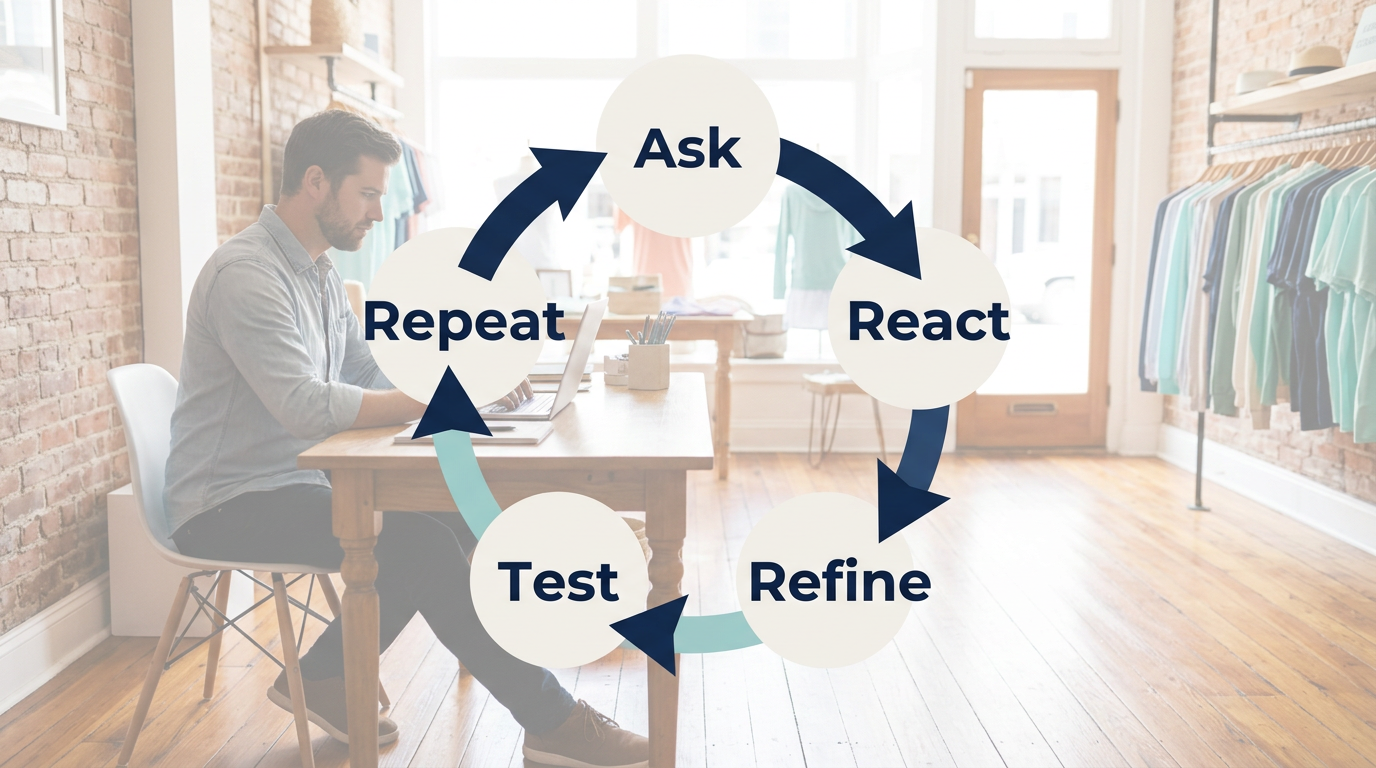
Then they judge AI on that one attempt. But the real power comes from prompting as a loop:

Ask → React → Refine → Test → Repeat

  1. Ask: Start with a simple, directional request.

    • “Give me 5 ways a neighborhood restaurant on James Island could increase Tuesday night traffic.”
  2. React: Tell AI what feels on‑brand and what doesn’t.

    • “Ideas 2 and 4 fit our vibe. Rewrite them to speak to busy parents in West Ashley and add realistic budget ranges.”
  3. Refine: Feed it real numbers and constraints from your business.

    • “We seat 60, average ticket is $28, kids’ meals are a strength, and we’re short‑staffed before 6 p.m. Adjust the ideas with that in mind.”
  4. Test: Ask AI to stress‑test its own ideas.

    • “Now, list what could go wrong with each idea in Charleston specifically (parking, weather, tourists, staffing) and how we’d adjust.”
  5. Repeat: Take what worked and run a new loop for the next asset:
    an email, a social post, a landing page, or even a script for a short Reels video.

Pro Tip

The “hack” isn’t a secret phrase; it’s expecting AI to improve through a back‑and‑forth
conversation, the same way you’d brief and coach an employee. The more you loop, the
more your content sounds like you—and like Charleston.

Why This Matters More in Charleston

Charleston is a relationship town. Prompt loops let you bake that relationship mindset into every AI conversation.

Local nuance, built in

  • Traffic on the Ravenel Bridge and parking on King Street.
  • Whether a business feels more “tourist‑y” or “locals know.”
  • How your brand shows up for neighborhoods like West Ashley, Park Circle, or Summerville.

Examples of Charleston‑aware prompts

  • A King Street boutique: “Rewrite this email as if I’m texting my best downtown customer
    who only shops when she’s already nearby for lunch, and mention walking distance from the Visitor Center.”
  • A Summerville home services company: “Adjust this offer to be realistic for a three‑truck
    team during peak pollen season and I‑26 traffic.”
  • A West Ashley restaurant: “Create Q&A content around ‘Where’s a quiet Tuesday date spot
    in West Ashley with parking?’ to show up better in AI‑driven search.”

Over time, your prompt loops become a way to teach AI who your customers are,
how they speak, and what life in the Charleston area is actually like.

Turning Prompt Loops into Real Marketing Outputs

Here are three everyday places to apply prompt loops in your next 90 days.

1. Campaign concepts and offers

  • Round 1: “Give me 10 May campaign ideas a Charleston retailer could run to drive in‑store foot traffic.”
  • Round 2: “Keep the 3 ideas that would photograph well in store and could be supported with a Post and Courier sponsored content package. Add rough timelines and necessary assets.”

2. Content built for AI search

AI‑driven “answer engines” sit between your customers and traditional search results, which
means generic keyword pages like “best restaurants Charleston” aren’t enough.

  • Round 1: “List questions Charleston residents might ask an AI assistant before choosing a brunch spot.”
  • Round 2: “Turn the best 5 into Q&A content for my website, referencing specific neighborhoods, occasions like bachelorette weekends, and parking or walkability.”

3. Creative for social and SMS

Local businesses that mix AI with email and SMS are seeing stronger engagement than those relying only on social algorithms.

  • Round 1: “Write 5 SMS messages inviting VIP customers to a last‑minute in‑store event on King Street this Saturday afternoon.”
  • Round 2: “Shorten each to under 140 characters, make them feel like a personal invite from the owner, and include a clear call‑to‑action.”

From one idea to many assets

From there, a quick extra loop can turn the same idea into a Reel script, a print ad headline,
and a sponsored content hook that all feel consistent but are tailored to each channel.

Where Charleston Businesses Go Next

Nationally, small businesses using AI report stronger efficiency and revenue gains—especially
when they plug it into marketing and customer communication instead of treating it as a side project.
Locally, Charleston brands that combine AI with strong first‑party data, simple automation, and
trusted platforms like The Post and Courier are already starting to pull ahead.

For Charleston owners, the next step isn’t “Should I be using AI?” The better question is:
“How can I build simple loops into what my team already does every week?”
A single well‑designed loop around your email list, social content, or in‑store events can be
enough to feel the difference in the next quarter.


If you think about your own marketing right now, what’s one recurring task—emails, social posts,
campaign ideas, or something else—that would be easiest to turn into your first consistent AI prompt loop?

local marketing

Charleston’s Choice 2026

The Big Idea

The Big Idea: Turn Local Love Into Measurable Growth
How Charleston’s Choice 2026 helps established favorites and emerging brands turn community love into year‑round revenue.
Charleston's Choice 2026
Charleston’s Choice 2026

11
years of Charleston’s Choice
celebrating local favorites

30,000+
engaged readers invited to
nominate & vote in 2026

6,000+
businesses nominated
in 2025 across the Lowcountry

125,000
votes cast in 2025,
creating massive word‑of‑mouth

Charleston’s Choice is not just a contest—it is the moment each year when the Lowcountry pauses to recognize the businesses they simply cannot live without. Now in its 11th year, the 2026 program again invites more than 30,000 engaged readers to nominate and vote for their favorite local businesses across 350+ categories, from food and nightlife to home services, health, shopping, and more.

In 2025, over 6,000 businesses earned nominations and more than 125,000 votes were cast, giving local brands massive word‑of‑mouth exposure and recognition that lasts long beyond the ballot. For 2026, Charleston’s Choice is designed to serve two core groups: long‑time favorites ready to defend and expand their reputation, and emerging businesses that want to get on the map fast.

Why It Matters for Established Favorites
Turn past wins into a 2026 loyalty engine.
If your business has been nominated or placed before, Charleston’s Choice is now part of your brand story—and 2026 is about amplifying that advantage. A pre‑populated ballot means prior nominees are already in the system, making it easier for loyal customers to find and support you during Phase 1 (May 1–29).

Built‑in head start
Upgrade listings into full‑funnel touchpoints.
Upgraded listings let you stand out with photos, descriptions, and links, turning a simple “vote” button into a full‑funnel brand touchpoint. Instead of a plain name on a list, customers see who you are, what you offer, and how to engage with you—right at the moment they are most motivated to choose their favorites.

Visibility + depth
Layer on sponsorships for market dominance.
Category, group, and package sponsorships add premium visibility: fixed 728×90 placements, print ads, and high‑impact digital positions across postandcourier.com and the ballot itself. Your name stays front and center while customers are actively deciding where to spend their money in the year ahead, creating proof you can use in advertising, hiring, and sales all year long.

Defend & grow

Why It’s a Launchpad for Newcomers
Compress years of awareness into one season.
For businesses that are new to Charleston’s Choice—or even new to the market—this promotion compresses years of awareness‑building into a focused, highly visible window. Readers are actively looking for “the next great” restaurant, shop, service provider, or experience in their neighborhood, giving newer brands a rare chance to be discovered alongside long‑time favorites.

Fast‑track exposure
Tell your story with upgraded listings.
An upgraded listing gives your brand the space to properly introduce itself: your story, your visuals, your links, and a built‑in share button that makes social amplification easy. Instead of hoping people stumble across your name, you give them a clear reason to click, explore, and vote.

Brand introduction
Choose packages that scale with your ambition.
Entry‑level options like upgraded listings or single‑category sponsorships provide an efficient path into a crowded marketplace. Bronze, Silver, and Gold packages add multi‑channel reach with bundled print, digital, and ballot exposure—helping new businesses quickly earn finalist or winner status, then leverage that badge on their website, signage, and marketing all year long.

Flexible investment

What’s New in 2026: Frictionless “Text to Vote”
Turn everyday interactions into votes.
The 2026 program introduces dedicated “Text to Vote” keywords, giving both established and new businesses a low‑friction way to turn everyday customer interactions into nominations and votes. With a simple SMS—no links, no QR codes needed—customers can take action in seconds, whether they are in your storefront, on the phone, or seeing your message on social or email.

Frictionless action
Add Text to Vote as a built‑in or standalone lever.
These keywords are included in packages, group and category sponsorships, and upgraded listings—and can also be sold on their own. That flexibility lets you test the waters or layer “Text to Vote” onto your existing marketing mix, creating a seamless bridge between your real‑world customer base and the Charleston’s Choice ballot.

New 2026 lever

How Charleston Businesses Plug In
Understand the three phases and pick your level.
Charleston’s Choice runs in three clear phases: Phase 1 nominations (May 1–29), Phase 2 finalist voting (June 5–July 3), and Phase 3 celebration and publication of winners and finalists in The Post and Courier in September. Throughout, you can choose the level of participation that matches your goals and budget—from upgraded listings to Bronze/Silver/Gold packages and the exclusive Title Sponsorship for maximum market dominance.

Structured timeline
Lock in sponsorships before they sell out.
To reserve a group or category sponsorship, or to discuss the right package for your business, contact charlestonschoice@postandcourier.com and secure placement before key categories are sold out. Whether you are defending your title or stepping into Charleston’s Choice for the first time, the big idea is simple: show up where local love is being measured—and turn that love into measurable business growth.

Act early

The Big Idea: Stop Asking AI For Help, Start Giving It a Job

The Big Idea

Time Saver: AI Workflow Automations
Five practical AI workflows Charleston teams can “hire” to reclaim hours every week.

70%
of knowledge workers expected
to have an AI “robot” by 2026

4–8
hours per week saved
by automating reporting alone

50%
faster research & prep
with AI‑generated briefs

60–70%
of reading, writing &
coordination time AI can touch

Most teams still use AI like a smart search bar. The real edge comes when you give it jobs instead of one‑off tasks. Click into each workflow below to see what to automate, how it works, and how to localize it for Charleston.

Gaining Ground: AI Workflows You Can “Hire” Today
🤖The Big Idea: From Prompts to Workflows

Most Charleston marketers still copy‑paste from AI into existing processes. The leaders are turning recurring loops—research, reporting, follow‑ups—into AI‑run workflows that quietly save hours every week while you focus on judgment calls.

Mindset shift

📚Workflow #1: Auto‑Research Briefs for Pitches

Drop a new company, category, or RFP into a simple “Research Queue” and let AI build a one‑page brief: recent news, local trends, likely goals, and objections. Your reps start every Charleston pitch with a cheat sheet instead of 10 browser tabs.

Pre‑meeting time saver

📝Workflow #2: Meeting Shadow Assistant

Use a transcription tool in Zoom or Teams, then feed the transcript to AI for summaries, decisions, action items, and a draft recap email. Instead of spending Sunday nights writing follow‑ups, you click “approve and send” after each key meeting.

Instant recaps

📥Workflow #3: Inbox Triage & Draft Replies

Route emails and Teams messages into “Urgent,” “Needs response,” and “FYI,” then let AI draft thoughtful replies in your voice. You batch‑review and send in 15–20 minutes instead of losing half a day to inbox avoidance and context‑switching.

Calmer inbox

Holding Steady: Core Channels, New Brains
✉️Workflow #4: Prompt‑to‑Campaign Builder

Modern platforms can take a plain‑language brief—“re‑engage 60‑day inactives in Mount Pleasant with a locals‑only offer”—and build the email series, subject lines, and timing for you. You still approve and localize, but AI handles the heavy lifting.

Faster campaigns

📊Workflow #5: Weekly “Robot Reporter” for Metrics

Every Monday morning, AI pulls your web, ads, newsletter, and CRM data, then writes a 10‑bullet summary: what’s up, what’s down, and three moves to make this week. You start with a story instead of a spreadsheet.

Reporting on autopilot

🧠Human‑in‑the‑Loop Guardrails

The best AI workflows don’t send anything without a person checking tone, accuracy, and timing. In Charleston’s relationship‑driven market, AI drafts and organizes while humans protect nuance, brand, and local context.

Still essential

⚙️Use the Tools You Already Have

You don’t need a new platform for every workflow. Start by connecting AI to the stack you already live in—HubSpot, email, calendar, project tools—so the friction goes down instead of up for your team.

Low‑lift adoption

Losing Steam: Busywork You Can Retire
🔁Random One‑Off Prompts

Asking AI to fix a sentence or brainstorm headlines is fine, but it doesn’t move the needle if the underlying workflow stays manual. The real ROI comes from automating loops you run every week, not one‑time requests.

Low leverage

📉Manual Reporting & Slide Decks

Copy‑pasting numbers into slides and then staring at them until a story appears is fast becoming a relic. AI can assemble the first draft of your dashboards and commentary so humans can focus on decisions, not data wrangling.

Replace with AI drafts

📅Unstructured Meetings Without Recaps

Meetings that generate no clear notes, decisions, or follow‑ups waste the very time you’re trying to save. Pairing transcription with AI‑written recaps turns every key conversation into a documented plan in minutes.

High hidden cost

🧩Always‑On Tabs & Context Switching

Jumping between inbox, calendar, reports, and chat all day quietly kills productivity. When AI runs the connective tissue—triage, summaries, and drafts—you recover focused blocks of time for deep work that actually moves the needle.

Quiet time drain

local marketing

Level Up Your Local Marketing 

The Big Idea

Level Up Your Local Marketing
What’s gaining ground, holding steady, and losing steam in Charleston marketing right now.

96%
of marketers
now using AI tools

22%
of local 3-pack results
now show paid ads (up from 1%)

49%
of orgs increasing
in-person event budgets

451%
increase in qualified leads
with marketing automation

Click into each trend below to see what Charleston marketers are doubling down on — and which tactics are quietly fading out.

Gaining Ground
🤖AEO & AI Search Visibility

Answer Engine Optimization is overtaking traditional SEO. Charleston firms need AI‑readable content to appear in Google AI Overviews and voice answers.

Rising fast in 2026

In‑Person & Local Events

Live events are back as a growth engine. Lowcountry roundtables, sponsor activations, and community meetups are delivering bottom‑funnel results.

49% budget increase

📈Marketing Automation

Email sequences, lead nurturing, and CRM automation are essential for Charleston firms to compete. Avg ROI: $42 for every $1 spent on email alone.

451% more leads

👥Buying Group Targeting

Smart marketers in Charleston are shifting from chasing individual leads to reaching entire decision‑making groups across finance, IT, and leadership.

New best practice

Holding Steady
📍Local SEO & Google Business

Still essential for Charleston visibility, but organic reach is shrinking as paid ads crowd 3‑pack results. Maintain & optimize — don’t abandon.

Requires paid boost

🎥Video Marketing

Short‑form video remains a reliable engagement driver for Charleston brands. 60% of B2B companies now invest here. Human‑led content outperforms polished production.

60% B2B adoption

✉️Email & SMS Campaigns

The Lowcountry’s most cost‑effective channel. 70% of marketers report positive ROI. Personalization and segmentation are now table stakes.

70% positive ROI

📝Content Marketing

Long‑form blogs and thought leadership hold value for credibility — especially for Charleston professional services. Quality over quantity is the 2026 standard.

75% plan to invest

Losing Steam
🔒Gated Content & MQL Funnels

Traditional “fill the form, get the PDF” tactics are losing traction. B2B buyers now research independently. Ungated content builds more trust in Charleston’s market.

Funnel control fading

📤Cold Outreach & SDR Blasts

Spray‑and‑pray email blasts and cold LinkedIn DMs are hitting diminishing returns. Charleston decision‑makers tune out generic outreach. Signal‑based targeting wins instead.

Declining conversion

🔍Keyword‑Only SEO

Stuffing pages with keywords without structured, AI‑readable content is obsolete. Google’s AI Overviews reward clarity and entity trust — not keyword density.

Organic clicks dropping

📅Generic Social Posting

Scheduled posts with no community strategy generate minimal pipeline. Charleston businesses need employee advocacy and authentic storytelling to stand out.

Low organic reach