AI In Advertising

AI in Advertising: What’s Legal, What’s Risky, and What to Do Now

The Big Idea

AI in Advertising: What’s Working, What Needs a Lawyer, and What to Stop Now
A practical legal and strategy guide for Lowcountry marketers using AI in ad creation — May 2026.

12+
FTC “Operation AI Comply”
enforcement actions since 2024

June ’26
New York’s AI synthetic performer
disclosure law takes effect

$0
Copyright protection for purely
AI-generated ads — you may not own it

You
Hold the legal risk when AI tools
generate infringing ad content

AI has made it faster and cheaper than ever to create ads, visuals, copy, and campaigns. But the legal ground underneath it is shifting fast — and in 2026, “the AI made it” is no longer a defense. Lowcountry marketers who understand the rules will move faster. The ones who don’t will move backward.

Gaining Ground: AI Tools Earning Their Keep
✍️AI-Assisted Copy & Campaign Ideation

Using AI to generate first drafts of ad copy, email subject lines, social posts, and campaign concepts is low-risk and high-value — as long as a human reviews, edits, and directs. That human layer also matters legally: substantial human creative input is what makes AI-assisted work potentially copyrightable. Treat AI as a copywriter’s assistant, not a replacement. Edit meaningfully. The more human direction goes in, the stronger your ownership claim on the output.

Low risk, high value

🎯AI-Powered Audience Targeting & Personalization

Modern ad platforms — including what P&C offers through its first-party data stack — integrate AI to match messages to the right local households at the right moment. This is where the real ROI lives: not just generating content faster, but getting it in front of verified Lowcountry residents who actually match your buyer profile. Layer AI-driven personalization on top of trusted, first-party audience data rather than third-party cookie pools that are evaporating.

Strongest local edge

🖼️Licensed AI Image Platforms

Not all AI image tools carry the same risk. Platforms like Adobe Firefly and Getty’s AI generator are trained exclusively on licensed content, which significantly reduces copyright exposure for commercial use. If you’re generating visuals for ads, this distinction matters more than most marketers realize. Default to licensed-source AI image tools for anything running in paid media. Check platform indemnification terms before publishing commercially.

Safer for paid media

📊AI for Reporting & Campaign Analytics

Automated performance summaries, weekly metrics digests, and AI-written campaign recaps are well-established, lower-risk applications — and they reclaim real hours for your team every week. AI assembles the data story; a human makes the decisions. Build a standing workflow that pulls your key ad metrics weekly and drafts a plain-language summary. The FTC has no quarrel with internal efficiency tools.

Hours back every week

Holding Steady: Needs Guardrails, Not Elimination
⚖️AI-Generated Visuals in Ads — Own It or Risk It

Purely AI-generated images — no meaningful human editing — are not copyrightable under current U.S. Copyright Office standards. That means a competitor could use the same output. More critically, if your AI image resembles a protected work, a real person, or a trademarked character, you are holding the legal exposure — not the AI vendor. Always review AI-generated images for visual similarity to known brands, artists, or people before publishing. Add real human creative direction and editing — not just a prompt — to strengthen your ownership position. Document your process.

Document everything

🎙️AI-Generated Voices & Synthetic Performers

Voice cloning and synthetic spokespeople are powerful — and now specifically regulated. Starting June 2026, New York requires conspicuous disclosure when ads use AI-generated synthetic performers (digitally created humans that appear real). Violations carry civil penalties up to $5,000 per offense, with more states and federal action likely to follow. Get ahead of it: disclose AI-generated performers in your creative even in markets where it’s not yet legally required. In a relationship-driven market like Charleston, transparency is itself a competitive advantage.

Disclose now, not later

📋Vendor Terms & Indemnification — Read the Fine Print

Most AI platform terms push copyright and infringement risk back onto the user. If a rights holder sues over an AI-generated ad, the AI company is typically not your defense. Before you publish: Does your platform grant commercial rights to outputs? Does it cover paid media and broadcast? Does it indemnify you for copyright claims, or disclaim liability entirely? Build a simple intake log for any AI tool used in ad production — which platform, which plan, who wrote the prompts, where it will run. That documentation creates a defensible record if questions arise later.

You hold the risk

Losing Steam: Stop Doing These Now
🚫Claiming “Full AI Automation” Without Proof

The FTC’s enforcement pattern is clear: exaggerating what AI can do is a consumer protection violation. Operation AI Comply has targeted inflated capability claims, including a $48.6 million settlement over a company that promised “nearly 100%” automation when users had to do most tasks manually. If you’re advertising AI-powered services to clients or customers, apply the same standard you’d apply to any performance claim: have proof before you say it.

FTC enforcement target

🎨Mimicking Artists, Voices, or Recognizable Styles

“Inspired by” is not a legal standard. AI image generators trained on vast libraries can produce content that closely resembles protected works — and if that happens in your ad, the infringement exposure belongs to you, not the AI. Prompting a tool to generate something “in the style of” a known artist, or using a synthetic voice that sounds like a public figure, is a lawsuit waiting to happen in commercial advertising. Avoid it. Describe the aesthetic elements you want instead of referencing specific creators.

High litigation risk

🤖Publishing AI Content Without a Human Review Step

Every workflow that sends AI-generated content directly into the world — copy, images, claims, reviews — without a human checkpoint is a liability. The FTC has made clear there is no AI exemption from existing consumer protection laws, and AI-generated content that turns out to be false or misleading is still false and misleading. Always build a mandatory human review step into every AI content workflow, no exceptions.

No AI exemption exists

Local Example — Mount Pleasant

A Mount Pleasant home goods retailer wanted to cut production time on monthly email campaigns. They built a workflow using AI for first-draft copy layered onto P&C’s targeted email list to reach verified local homeowners. A human copywriter reviewed and localized every draft — checking accuracy and adding the brand voice AI alone couldn’t replicate. They used Adobe Firefly for lifestyle imagery (licensed source), documented their process, and disclosed AI use in internal production notes. Result: campaigns out in half the time, higher open rates from better audience targeting, and no legal exposure. The AI did the heavy lifting; the human kept the brand and the business protected.

AI Ad Use Case — Risk at a Glance
AI Use Case Risk Level Key Safeguard
Copy drafts + human editing 🟢 Low Human review before publish
Licensed AI image platforms 🟡 Low–Medium Verify platform indemnification
Generic AI image generators 🟠 Medium–High Check terms; document workflow
Synthetic voice / performer 🔴 High Disclose conspicuously
Style mimicry / voice cloning 🔴 Very High Avoid for commercial ads
AI-only content, no human review 🔴 High Always add human checkpoint

Implementation Checklist
  • Audit which AI tools your team currently uses in ad production
  • Confirm each platform’s commercial use rights and indemnification terms
  • Switch to licensed-source AI image tools (Firefly, Getty AI) for paid media
  • Add a mandatory human review step to every AI content workflow
  • Create an intake log: tool, plan, prompt author, reviewer, placement
  • Draft an internal disclosure policy for AI-generated performers
  • Review any existing marketing claims about AI capabilities for FTC compliance
  • Brief agency partners on your AI use standards and documentation requirements

Ready to build AI into your ad strategy — without the legal landmines?

AI is moving fast. The legal framework is moving almost as fast. The marketers who win won’t be the ones who use AI the most — they’ll be the ones who use it the most responsibly, with the right tools, the right partners, and verified local audience data underneath it all.

The Post and Courier Advertising team works with Lowcountry businesses every day on campaigns that combine smart targeting, trusted reach, and first-party data no algorithm can replicate. If you want to talk through building AI into your strategy the right way, we’re a good place to start.

📧 advertising@postandcourier.com

Sources: FTC.gov, ArentFox Schiff, Davis Wright Tremaine, U.S. Copyright Office, Congress.gov • May 2026
thebigidea — Post and Courier Advertising
The Big Idea

Meet Karen Mead: Connector Behind P&C Campaigns

The Big Idea

Meet Karen Mead, the “Connector” Behind Charleston Campaigns That Move the Needle
How one Post and Courier strategist turns ad placements into real partnerships

Great local marketing isn’t about buying space — it’s about being connected to the right audience in the right way. Karen Mead has built her career on exactly that, and it’s reshaping how Charleston businesses think about growth.

Karen Mead, Multimedia Account Representative at The Post and Courier
A Newspaper That’s Really a Marketing Partner

Ask Karen Mead what she does at The Post and Courier and you won’t hear “I sell ads.” You’ll hear something closer to a mission statement.

“I usually say I help local businesses grow by connecting them with the right audience in meaningful ways,” she says. “At The Post and Courier, we’re not just a newspaper — we’re a full digital services agency and a one-stop shop for marketing solutions.”

That distinction matters. The Post and Courier today reaches across South Carolina with 15 newspapers and websites, giving Charleston brands a way to become part of the conversation in the communities they serve — locally and statewide. For Karen, the appeal of the work is the blend: “I love being able to combine storytelling, strategy, and relationships to create campaigns that actually move the needle.”

“Charleston Is a Relationship City Disguised as a Tourist City”

Spend five minutes talking with Karen about the local market and one idea surfaces fast: Charleston runs on relationships and authenticity.

“Everyone knows someone, and authenticity matters,” she says. “You can’t market here with a one-size-fits-all approach because the vibe in Mount Pleasant is different from downtown, which is different from West Ashley or Johns Island.”

It’s a quietly powerful insight for any advertiser. People in the Lowcountry support businesses that feel local, personal, and community-minded — and that conviction shapes every campaign Karen builds. It’s also why The Post and Courier’s first-party local audience matters so much: these are real Lowcountry residents, not out-of-market impressions, which makes the personalization Karen cares about actually possible.

Her Secret Sauce: “Connector Energy”

Every strategist has a signature. Karen’s has a name.

“I’d call it ‘connector energy,'” she says. “I genuinely love connecting businesses with ideas, audiences, and opportunities they may not have thought about before.”

It shows up in how she brainstorms campaigns, builds long-term relationships, and thinks past a single ad placement. The question she keeps coming back to: “How can we make this feel bigger, smarter, and more memorable?”

The Whiteboard Session She Still Thinks About

Ask Karen for a moment that stuck with her, and she goes straight to a client who came in wanting something traditional — and left thinking differently about marketing entirely.

“After a few conversations, I ended up in a whiteboard session with my digital lead mapping out the best tactics to truly help the client grow,” she says. “We broke down their audience, brainstormed creative approaches, and built a much more strategic, integrated campaign than they originally imagined.”

The payoff wasn’t just performance. “The client later told us it changed the way they thought about marketing entirely — because they finally felt understood instead of just sold to. Those are the moments that stay with me: when collaboration, creativity, and strategy all come together to make something meaningful.”

What “Different” Should Feel Like

Picture a Charleston business owner two years from now saying that working with The Post and Courier team “feels different.” Karen knows exactly what she hopes they mean.

“I hope they mean we listened. That we cared about their goals like they were our own,” she says. “I want clients to feel like they have a creative partner who is proactive, collaborative, and genuinely invested in their success — not someone who just drops an ad and disappears.”

Her version of a great partnership? “Personal, strategic, and fun all at the same time.”

Lightning Round
💡Go-to spot when you need to think big about a campaign?

“Honestly, a whiteboard session at the office with my digital lead. That’s usually where the best ideas happen — throwing out creative concepts, mapping out audience strategy, and building campaigns that really make an impact.”

Whiteboard energy

🌶A spicy marketing opinion you secretly stand by?

“Not every business needs to go viral. Consistency, trust, and community presence will outperform a flashy one-hit campaign almost every time.”

Consistency wins

✏️“Local advertising works best when we ______.”

“…understand the audience and tell a story that truly connects with them.”

Audience first

A fun fact others may not know about you?

“I genuinely love the process of matching the right campaign and strategy to each client. Every business is different, and I enjoy figuring out the perfect mix of ideas, audience, and messaging to help them succeed.”

Made to match

Answer Box

Short answer: Karen Mead is a Multimedia Account Representative at The Post and Courier who helps Lowcountry businesses grow by pairing local storytelling, audience strategy, and long-term relationships — treating advertising as a partnership, not a transaction.

  • Role: Connects Charleston-area businesses with the right local audiences through The Post and Courier’s full-service marketing offering.
  • Philosophy: “Charleston is a relationship city” — authenticity and community-minded marketing win here.
  • Signature strength: “Connector energy” — linking businesses to ideas, audiences, and opportunities beyond a single ad placement.
  • Approach: Collaborative whiteboard strategy sessions that turn traditional ad requests into integrated, audience-driven campaigns.
  • Belief: Consistency, trust, and community presence outperform one-hit viral campaigns.
  • Do this next: If you want a marketing partner who listens first and builds strategy around your goals, contact The Post and Courier advertising team.
Work With a Partner Who Connects the Dots

Karen’s approach is a good preview of what working with The Post and Courier feels like: local expertise, real audience data, and strategy built around your goals — not a one-size-fits-all ad buy.

If you want help bringing this kind of thinking to your own Charleston or South Carolina business, reach out to The Post and Courier advertising team at advertising@postandcourier.com for a strategy conversation.

Email Marketing with The Post and Courier

The Big Idea

Land in 145,000 Local Inboxes That Already Said “Yes”
How The Post and Courier’s email marketing reaches opted-in Charleston and South Carolina audiences

Reaching local customers keeps getting harder and more expensive. Social feeds are crowded and pay-to-play, third-party cookies are disappearing, and programmatic display often spends your budget on out-of-market impressions instead of real neighbors. Email bucks the trend — it’s a direct line to a person who chose to hear from a brand they trust.

145,012
Deduplicated opt-in subscribers across the SC footprint

79,865
Opt-ins on the flagship Charleston O&O Sales list

22.28%
Average open rate across all lists in April

8
Charleston-metro interest segments to target

That’s the advantage of an owned-and-operated email audience. The Post and Courier has built its database from real residents who opted in — so when your email goes out through P&C, it arrives with the credibility of a local news brand readers already invited into their inbox. Here’s how to put it to work.

How Post and Courier Email Marketing Works

🎯Play 1: Choose your reach — database, segment, or market


P&C email marketing flexes to the size of your goal. Full Database Email Marketing sends your message to the entire O&O Sales list — 79,865 Charleston-area inboxes — best for broad awareness, grand openings, and wide-appeal offers. Segmented Emails narrow the send to a defined interest audience so your spend goes only to the people most likely to act. And because P&C operates across the state, you can also target a specific market: Columbia, Myrtle Beach/Georgetown, Aiken, Greenville, Summerville, Berkeley, Beaufort, the Pee Dee and more. Match the format to the offer, not the other way around.

🎬Play 2: Target the segment that actually buys


Segmented sends reach a defined Charleston-metro interest audience instead of paying to reach everyone. A landscaping company reaches Home & Garden; a boutique reaches Shopping; a CPA firm reaches Business.

Segment Subscribers
Food 6,008
Family 3,873
Events & Entertainment 3,048
Sports 1,881
Shopping 1,523
Home & Garden 1,065
Beauty & Health 741
Business 720

Seasonal options like Events and Holiday Events are also available for time-sensitive promotions.


Play 3: Send custom-designed creative worth opening


Every P&C email is a custom-coded, professionally designed send — not a drag-and-drop template (see an example here). The email is sent from The Post and Courier, with your branding and messaging featured within the body — so it carries P&C’s deliverability and trust while still being unmistakably yours. The emails readers actually engage with share a pattern: a clear update, a real offer, and a reason to act now — latest sales, operational updates, milestones. Lead with the benefit, keep it scannable, and give one obvious call to action that points to your website or your front door.

📊Play 4: Read the signal and refine


Every open and click is data. P&C tracks engagement on every send, so you can see which subject lines land, which offers convert, and which segment responds best — then tune the next send around it. Email marketing is a test-and-learn loop, not a one-shot.
⭐ Limited-Time Offer: BOGO Half-Off Email

We’re running a buy-one-get-one half-off promotion on our O&O Sales & Special Offer email list — currently 79,865 opt-ins, with open rates ranging from 18–22%. Emails are sent from The Post and Courier while featuring your branding and messaging within the body.

First email $1,750
Second email (BOGO half off) $875
Three-email bundle — $1,000 per email $3,000 total

Contact the Advertising team to lock in the promotional rate.

💡 See It In Action: A Mount Pleasant Restaurant Fills Its Slow Nights

A family-owned restaurant on Coleman Boulevard wants more covers on weeknights. Instead of boosting a social post to a broad, unverified audience, they run a Segmented Email to P&C’s Food audience — 6,008 opted-in local readers who have signaled interest in dining. The custom-designed email features a Tuesday-through-Thursday prix-fixe offer and a reservation link. Because it lands in inboxes that already trust the P&C brand and chose to receive it, the open and click numbers give the restaurant a clear read on demand — and momentum for the next send.

Answer Box

Short answer: The Post and Courier’s email marketing lets local businesses send a custom-designed message to 145,000+ opted-in South Carolina subscribers — as a full-database send, a targeted interest segment, or a specific market.

  • Total reach: 145,012 deduplicated opt-in subscribers across the SC footprint
  • Charleston flagship: the O&O Sales list reaches 79,865 inboxes
  • Engagement: 22.28% average open rate in April
  • Full Database: your message to the entire O&O Sales list — best for broad awareness
  • Segmented: target a Charleston interest audience — Food, Family, Events & Entertainment, Sports, Shopping, Home & Garden, Beauty & Health, Business
  • By market: Columbia, Myrtle Beach/Georgetown, Aiken, Greenville, Summerville and more
  • Creative: every send is custom-coded and professionally designed
  • Current offer: BOGO half-off on the O&O Sales list — first email $1,750, second $875, or a 3-email bundle at $1,000 each ($3,000 total)

Do this next: decide whether your offer is broad, segment-specific, or market-specific, then contact the P&C Advertising team to plan the send.

Implementation Checklist
  • ☐  Define your goal — website traffic, foot traffic, sales, or awareness
  • ☐  Decide: full database, a specific interest segment, or a specific market
  • ☐  If segmenting, pick your audience from the eight interest categories
  • ☐  Build one clear offer with a single, obvious call to action
  • ☐  Write a benefit-first subject line and scannable body copy
  • ☐  Provide brand assets so the team can build your custom creative
  • ☐  Include links to both your website and your location and hours
  • ☐  Schedule the send with the P&C Advertising team
  • ☐  Review open and click results and plan the next send
Ready to land in local inboxes?

If you want help putting this to work for your business locally, contact The Post and Courier Advertising team. They’ll help you choose the right format, pick the segment or market that fits your customer, and plan a campaign around your goals and budget.

advertising@postandcourier.com

Loop Prompts

Big Idea: Charleston Businesses Don’t Need Perfect Prompts — They Need Prompt Loops

Why this “prompt loop” matters now

If you’re a Lowcountry business owner, you’ve probably tried AI the way most people do:
open ChatGPT, type one big request, skim the answer, and decide whether it’s “good enough.”
The problem isn’t the tool. It’s the expectation that one prompt should magically deliver a
finished campaign, blog post, or marketing plan.

Across the country, more and more small businesses are folding AI into their day-to-day work—
but the real advantage is shifting from “use AI once in a while” to “build repeatable loops
that get smarter every week.” For Charleston, where relationships and local nuance matter,
that shift is especially important.

From one‑off prompts to loops

  • Single-shot prompts lead to generic, forgettable content.
  • Prompt loops turn AI into a brainstorming and editing partner.
  • Each loop adds more Charleston context—your customers, your streets, your reality.

The Prompt Loop Advantage

Most owners use what could be called “single‑shot prompting”:

  • “Write a marketing plan for my Charleston restaurant.”
  • “Draft Facebook posts for my Mount Pleasant spa.”

Then they judge AI on that one attempt. But the real power comes from prompting as a loop:

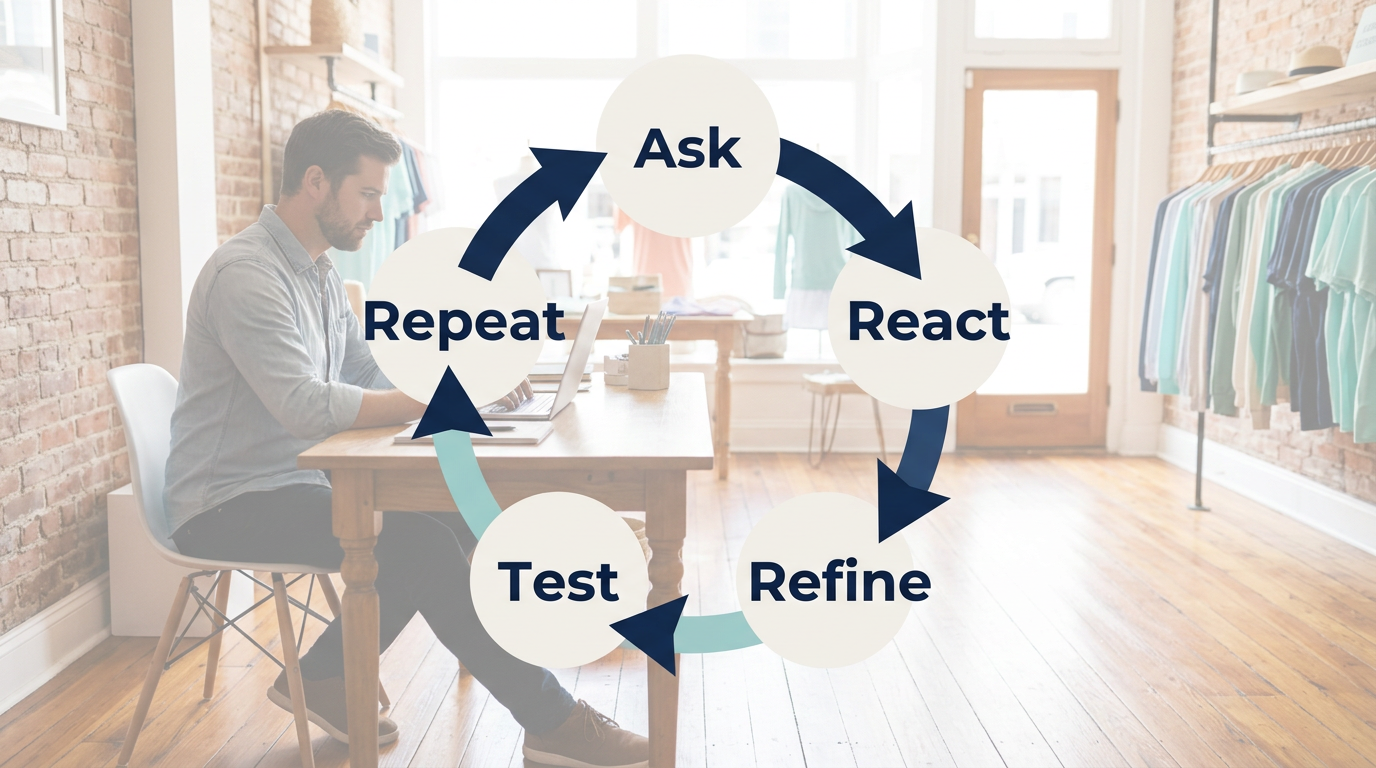
Ask → React → Refine → Test → Repeat

  1. Ask: Start with a simple, directional request.

    • “Give me 5 ways a neighborhood restaurant on James Island could increase Tuesday night traffic.”
  2. React: Tell AI what feels on‑brand and what doesn’t.

    • “Ideas 2 and 4 fit our vibe. Rewrite them to speak to busy parents in West Ashley and add realistic budget ranges.”
  3. Refine: Feed it real numbers and constraints from your business.

    • “We seat 60, average ticket is $28, kids’ meals are a strength, and we’re short‑staffed before 6 p.m. Adjust the ideas with that in mind.”
  4. Test: Ask AI to stress‑test its own ideas.

    • “Now, list what could go wrong with each idea in Charleston specifically (parking, weather, tourists, staffing) and how we’d adjust.”
  5. Repeat: Take what worked and run a new loop for the next asset:
    an email, a social post, a landing page, or even a script for a short Reels video.

Pro Tip

The “hack” isn’t a secret phrase; it’s expecting AI to improve through a back‑and‑forth
conversation, the same way you’d brief and coach an employee. The more you loop, the
more your content sounds like you—and like Charleston.

Why This Matters More in Charleston

Charleston is a relationship town. Prompt loops let you bake that relationship mindset into every AI conversation.

Local nuance, built in

  • Traffic on the Ravenel Bridge and parking on King Street.
  • Whether a business feels more “tourist‑y” or “locals know.”
  • How your brand shows up for neighborhoods like West Ashley, Park Circle, or Summerville.

Examples of Charleston‑aware prompts

  • A King Street boutique: “Rewrite this email as if I’m texting my best downtown customer
    who only shops when she’s already nearby for lunch, and mention walking distance from the Visitor Center.”
  • A Summerville home services company: “Adjust this offer to be realistic for a three‑truck
    team during peak pollen season and I‑26 traffic.”
  • A West Ashley restaurant: “Create Q&A content around ‘Where’s a quiet Tuesday date spot
    in West Ashley with parking?’ to show up better in AI‑driven search.”

Over time, your prompt loops become a way to teach AI who your customers are,
how they speak, and what life in the Charleston area is actually like.

Turning Prompt Loops into Real Marketing Outputs

Here are three everyday places to apply prompt loops in your next 90 days.

1. Campaign concepts and offers

  • Round 1: “Give me 10 May campaign ideas a Charleston retailer could run to drive in‑store foot traffic.”
  • Round 2: “Keep the 3 ideas that would photograph well in store and could be supported with a Post and Courier sponsored content package. Add rough timelines and necessary assets.”

2. Content built for AI search

AI‑driven “answer engines” sit between your customers and traditional search results, which
means generic keyword pages like “best restaurants Charleston” aren’t enough.

  • Round 1: “List questions Charleston residents might ask an AI assistant before choosing a brunch spot.”
  • Round 2: “Turn the best 5 into Q&A content for my website, referencing specific neighborhoods, occasions like bachelorette weekends, and parking or walkability.”

3. Creative for social and SMS

Local businesses that mix AI with email and SMS are seeing stronger engagement than those relying only on social algorithms.

  • Round 1: “Write 5 SMS messages inviting VIP customers to a last‑minute in‑store event on King Street this Saturday afternoon.”
  • Round 2: “Shorten each to under 140 characters, make them feel like a personal invite from the owner, and include a clear call‑to‑action.”

From one idea to many assets

From there, a quick extra loop can turn the same idea into a Reel script, a print ad headline,
and a sponsored content hook that all feel consistent but are tailored to each channel.

Where Charleston Businesses Go Next

Nationally, small businesses using AI report stronger efficiency and revenue gains—especially
when they plug it into marketing and customer communication instead of treating it as a side project.
Locally, Charleston brands that combine AI with strong first‑party data, simple automation, and
trusted platforms like The Post and Courier are already starting to pull ahead.

For Charleston owners, the next step isn’t “Should I be using AI?” The better question is:
“How can I build simple loops into what my team already does every week?”
A single well‑designed loop around your email list, social content, or in‑store events can be
enough to feel the difference in the next quarter.


If you think about your own marketing right now, what’s one recurring task—emails, social posts,
campaign ideas, or something else—that would be easiest to turn into your first consistent AI prompt loop?

local marketing

Charleston’s Choice 2026

The Big Idea

The Big Idea: Turn Local Love Into Measurable Growth
How Charleston’s Choice 2026 helps established favorites and emerging brands turn community love into year‑round revenue.
Charleston's Choice 2026
Charleston’s Choice 2026

11
years of Charleston’s Choice
celebrating local favorites

30,000+
engaged readers invited to
nominate & vote in 2026

6,000+
businesses nominated
in 2025 across the Lowcountry

125,000
votes cast in 2025,
creating massive word‑of‑mouth

Charleston’s Choice is not just a contest—it is the moment each year when the Lowcountry pauses to recognize the businesses they simply cannot live without. Now in its 11th year, the 2026 program again invites more than 30,000 engaged readers to nominate and vote for their favorite local businesses across 350+ categories, from food and nightlife to home services, health, shopping, and more.

In 2025, over 6,000 businesses earned nominations and more than 125,000 votes were cast, giving local brands massive word‑of‑mouth exposure and recognition that lasts long beyond the ballot. For 2026, Charleston’s Choice is designed to serve two core groups: long‑time favorites ready to defend and expand their reputation, and emerging businesses that want to get on the map fast.

Why It Matters for Established Favorites
Turn past wins into a 2026 loyalty engine.
If your business has been nominated or placed before, Charleston’s Choice is now part of your brand story—and 2026 is about amplifying that advantage. A pre‑populated ballot means prior nominees are already in the system, making it easier for loyal customers to find and support you during Phase 1 (May 1–29).

Built‑in head start
Upgrade listings into full‑funnel touchpoints.
Upgraded listings let you stand out with photos, descriptions, and links, turning a simple “vote” button into a full‑funnel brand touchpoint. Instead of a plain name on a list, customers see who you are, what you offer, and how to engage with you—right at the moment they are most motivated to choose their favorites.

Visibility + depth
Layer on sponsorships for market dominance.
Category, group, and package sponsorships add premium visibility: fixed 728×90 placements, print ads, and high‑impact digital positions across postandcourier.com and the ballot itself. Your name stays front and center while customers are actively deciding where to spend their money in the year ahead, creating proof you can use in advertising, hiring, and sales all year long.

Defend & grow

Why It’s a Launchpad for Newcomers
Compress years of awareness into one season.
For businesses that are new to Charleston’s Choice—or even new to the market—this promotion compresses years of awareness‑building into a focused, highly visible window. Readers are actively looking for “the next great” restaurant, shop, service provider, or experience in their neighborhood, giving newer brands a rare chance to be discovered alongside long‑time favorites.

Fast‑track exposure
Tell your story with upgraded listings.
An upgraded listing gives your brand the space to properly introduce itself: your story, your visuals, your links, and a built‑in share button that makes social amplification easy. Instead of hoping people stumble across your name, you give them a clear reason to click, explore, and vote.

Brand introduction
Choose packages that scale with your ambition.
Entry‑level options like upgraded listings or single‑category sponsorships provide an efficient path into a crowded marketplace. Bronze, Silver, and Gold packages add multi‑channel reach with bundled print, digital, and ballot exposure—helping new businesses quickly earn finalist or winner status, then leverage that badge on their website, signage, and marketing all year long.

Flexible investment

What’s New in 2026: Frictionless “Text to Vote”
Turn everyday interactions into votes.
The 2026 program introduces dedicated “Text to Vote” keywords, giving both established and new businesses a low‑friction way to turn everyday customer interactions into nominations and votes. With a simple SMS—no links, no QR codes needed—customers can take action in seconds, whether they are in your storefront, on the phone, or seeing your message on social or email.

Frictionless action
Add Text to Vote as a built‑in or standalone lever.
These keywords are included in packages, group and category sponsorships, and upgraded listings—and can also be sold on their own. That flexibility lets you test the waters or layer “Text to Vote” onto your existing marketing mix, creating a seamless bridge between your real‑world customer base and the Charleston’s Choice ballot.

New 2026 lever

How Charleston Businesses Plug In
Understand the three phases and pick your level.
Charleston’s Choice runs in three clear phases: Phase 1 nominations (May 1–29), Phase 2 finalist voting (June 5–July 3), and Phase 3 celebration and publication of winners and finalists in The Post and Courier in September. Throughout, you can choose the level of participation that matches your goals and budget—from upgraded listings to Bronze/Silver/Gold packages and the exclusive Title Sponsorship for maximum market dominance.

Structured timeline
Lock in sponsorships before they sell out.
To reserve a group or category sponsorship, or to discuss the right package for your business, contact charlestonschoice@postandcourier.com and secure placement before key categories are sold out. Whether you are defending your title or stepping into Charleston’s Choice for the first time, the big idea is simple: show up where local love is being measured—and turn that love into measurable business growth.

Act early
The Big Idea

Get to Know: Pamela Brownstein

The Big Idea

Get to Know Pamela Brownstein
Niche Content Editor, Lowcountry Parent & More


Pamela Brownstein, Niche Content Editor at The Post and Courier

As the Niche Content Editor, Pamela Brownstein wears many hats and brings more than 20 years of experience working for publications statewide as a writer, editor and graphic designer. Her main role is that of Lowcountry Parent editor, but she also serves as the editor of The Post and Courier’s weekly real estate section, and previously worked as the editor of Tideline, a niche brand that focused on fishing and outdoor recreation.

Although her position focuses on editorial content rather than sales, she works closely with the advertising and marketing teams to support a well-rounded approach that benefits readers and clients alike.

Award-Winning Experience

After earning a degree in journalism from Penn State University, Brownstein moved from New Jersey to South Carolina in 2002, and has been working at newspapers and other publications ever since. She’s worked at The Beaufort Gazette, The Island Packet, Hilton Head Monthly Magazine, The Island News, Mount Pleasant Magazine, Charleston Moms and The Daniel Island News. She met her husband, Daniel, when they were both working at The Island Packet, and they lived in Beaufort, SC, for many years before moving to Charleston.

Over the course of her career, Brownstein has won 25 South Carolina Press Association Awards in a variety of categories, from page design, headline writing and column writing — including two awards for Lowcountry Parent in the feature magazine category.

“I’m a competitive person, so I’m proud of my accomplishments, but really I hope my experience shows that I care a lot about what I do and I work hard to produce quality results.”

“I’m a competitive person, so I’m proud of my accomplishments, but really I hope my experience shows that I care a lot about what I do and I work hard to produce quality results,” she said. “I hold myself to a high standard, and that’s why I like working for The Post and Courier, because the company believes in quality journalism and sets high standards for all of its brands and publications.”

A Bridge Behind the Scenes

Brownstein, who recently celebrated four years with the company, said she often sees her role as a bridge between different departments, and has strong working relationships that extend from reporters and photographers in the newsroom to the print and production staff based out of the press facility in North Charleston.

She works closely with her colleagues in the advertising department, as well as with those in events, marketing and King & Columbus, the in-house advertising agency, to help create cohesive reader and client experiences across brands and platforms.

“I feel very fortunate to work with so many talented people, and my position affords me the benefit of being involved with so many aspects of the company.”

“I feel very fortunate to work with so many talented people, and my position affords me the benefit of being involved with so many aspects of the company, so I have a good understanding of how things work and who does what, and I try to use this knowledge to create the best product and experience for our readers — whether it’s a print publication or a social media campaign or through Lowcountry Parent’s website or newsletter,” she said.

Creating Quality Content

Lowcountry Parent is a brand that has a great reputation in the community, and being able to continue that tradition of excellence and bringing families interesting, relevant and well-written content is the best part of my job,” Brownstein revealed.

Through the website, print magazine, newsletter and vibrant social media presence, Brownstein works across all of these platforms to produce content that is helpful and informative, in order to remain the top resource for parents — and in a position to attract advertisers as well.

Together with Multi-Media Account Executive Ashley Castanas, the two working moms collaborate to create a product that highlights the people, places, businesses and events that make Charleston such a great place to raise a family.

Community Connections

Staying engaged with the community comes naturally for Brownstein because she enjoys talking with people and hearing their stories, and having two active kids keeps her out and about and busy after work and on the weekends.

“When we moved to Mount Pleasant 10 years ago, I didn’t know anyone. I would literally talk to people everywhere I went — at the playground, in line at the grocery store, walking around the neighborhood,” she said.

Getting to know people and making connections has paid off because she added, “Now I run into someone I know nearly everywhere I go!”

Whether through her kids’ school, sports or other organizations, Brownstein builds relationships with people in the community and uses those networks to improve her role at The Post and Courier. “Being involved with so many different groups gives me a better perspective as far as what matters to people or what parents are concerned about, and that helps me understand what topics to cover and what kind of stories to write that will be of interest to our readers and clients,” she said.

Lightning Round Revelations

Q: What’s your go-to Charleston spot when you need to think big about a campaign?
A: I like to go for a walk on the beach on Sullivan’s Island.

Q: What’s a fun fact others may not know about you?
A: I love live music and going to concerts, and Charleston has so many awesome venues to see so many different kinds of music! I’m really excited about High Water Festival too.
Also, I published an adorable children’s book of poetry titled, “LowKu: Haikus of the Lowcountry.”

The Big Idea: Stop Asking AI For Help, Start Giving It a Job

The Big Idea

Time Saver: AI Workflow Automations
Five practical AI workflows Charleston teams can “hire” to reclaim hours every week.

70%
of knowledge workers expected
to have an AI “robot” by 2026

4–8
hours per week saved
by automating reporting alone

50%
faster research & prep
with AI‑generated briefs

60–70%
of reading, writing &
coordination time AI can touch

Most teams still use AI like a smart search bar. The real edge comes when you give it jobs instead of one‑off tasks. Click into each workflow below to see what to automate, how it works, and how to localize it for Charleston.

Gaining Ground: AI Workflows You Can “Hire” Today
🤖The Big Idea: From Prompts to Workflows

Most Charleston marketers still copy‑paste from AI into existing processes. The leaders are turning recurring loops—research, reporting, follow‑ups—into AI‑run workflows that quietly save hours every week while you focus on judgment calls.

Mindset shift

📚Workflow #1: Auto‑Research Briefs for Pitches

Drop a new company, category, or RFP into a simple “Research Queue” and let AI build a one‑page brief: recent news, local trends, likely goals, and objections. Your reps start every Charleston pitch with a cheat sheet instead of 10 browser tabs.

Pre‑meeting time saver

📝Workflow #2: Meeting Shadow Assistant

Use a transcription tool in Zoom or Teams, then feed the transcript to AI for summaries, decisions, action items, and a draft recap email. Instead of spending Sunday nights writing follow‑ups, you click “approve and send” after each key meeting.

Instant recaps

📥Workflow #3: Inbox Triage & Draft Replies

Route emails and Teams messages into “Urgent,” “Needs response,” and “FYI,” then let AI draft thoughtful replies in your voice. You batch‑review and send in 15–20 minutes instead of losing half a day to inbox avoidance and context‑switching.

Calmer inbox

Holding Steady: Core Channels, New Brains
✉️Workflow #4: Prompt‑to‑Campaign Builder

Modern platforms can take a plain‑language brief—“re‑engage 60‑day inactives in Mount Pleasant with a locals‑only offer”—and build the email series, subject lines, and timing for you. You still approve and localize, but AI handles the heavy lifting.

Faster campaigns

📊Workflow #5: Weekly “Robot Reporter” for Metrics

Every Monday morning, AI pulls your web, ads, newsletter, and CRM data, then writes a 10‑bullet summary: what’s up, what’s down, and three moves to make this week. You start with a story instead of a spreadsheet.

Reporting on autopilot

🧠Human‑in‑the‑Loop Guardrails

The best AI workflows don’t send anything without a person checking tone, accuracy, and timing. In Charleston’s relationship‑driven market, AI drafts and organizes while humans protect nuance, brand, and local context.

Still essential

⚙️Use the Tools You Already Have

You don’t need a new platform for every workflow. Start by connecting AI to the stack you already live in—HubSpot, email, calendar, project tools—so the friction goes down instead of up for your team.

Low‑lift adoption

Losing Steam: Busywork You Can Retire
🔁Random One‑Off Prompts

Asking AI to fix a sentence or brainstorm headlines is fine, but it doesn’t move the needle if the underlying workflow stays manual. The real ROI comes from automating loops you run every week, not one‑time requests.

Low leverage

📉Manual Reporting & Slide Decks

Copy‑pasting numbers into slides and then staring at them until a story appears is fast becoming a relic. AI can assemble the first draft of your dashboards and commentary so humans can focus on decisions, not data wrangling.

Replace with AI drafts

📅Unstructured Meetings Without Recaps

Meetings that generate no clear notes, decisions, or follow‑ups waste the very time you’re trying to save. Pairing transcription with AI‑written recaps turns every key conversation into a documented plan in minutes.

High hidden cost

🧩Always‑On Tabs & Context Switching

Jumping between inbox, calendar, reports, and chat all day quietly kills productivity. When AI runs the connective tissue—triage, summaries, and drafts—you recover focused blocks of time for deep work that actually moves the needle.

Quiet time drain

local marketing

Level Up Your Local Marketing 

The Big Idea

Level Up Your Local Marketing
What’s gaining ground, holding steady, and losing steam in Charleston marketing right now.

96%
of marketers
now using AI tools

22%
of local 3-pack results
now show paid ads (up from 1%)

49%
of orgs increasing
in-person event budgets

451%
increase in qualified leads
with marketing automation

Click into each trend below to see what Charleston marketers are doubling down on — and which tactics are quietly fading out.

Gaining Ground
🤖AEO & AI Search Visibility

Answer Engine Optimization is overtaking traditional SEO. Charleston firms need AI‑readable content to appear in Google AI Overviews and voice answers.

Rising fast in 2026

In‑Person & Local Events

Live events are back as a growth engine. Lowcountry roundtables, sponsor activations, and community meetups are delivering bottom‑funnel results.

49% budget increase

📈Marketing Automation

Email sequences, lead nurturing, and CRM automation are essential for Charleston firms to compete. Avg ROI: $42 for every $1 spent on email alone.

451% more leads

👥Buying Group Targeting

Smart marketers in Charleston are shifting from chasing individual leads to reaching entire decision‑making groups across finance, IT, and leadership.

New best practice

Holding Steady
📍Local SEO & Google Business

Still essential for Charleston visibility, but organic reach is shrinking as paid ads crowd 3‑pack results. Maintain & optimize — don’t abandon.

Requires paid boost

🎥Video Marketing

Short‑form video remains a reliable engagement driver for Charleston brands. 60% of B2B companies now invest here. Human‑led content outperforms polished production.

60% B2B adoption

✉️Email & SMS Campaigns

The Lowcountry’s most cost‑effective channel. 70% of marketers report positive ROI. Personalization and segmentation are now table stakes.

70% positive ROI

📝Content Marketing

Long‑form blogs and thought leadership hold value for credibility — especially for Charleston professional services. Quality over quantity is the 2026 standard.

75% plan to invest

Losing Steam
🔒Gated Content & MQL Funnels

Traditional “fill the form, get the PDF” tactics are losing traction. B2B buyers now research independently. Ungated content builds more trust in Charleston’s market.

Funnel control fading

📤Cold Outreach & SDR Blasts

Spray‑and‑pray email blasts and cold LinkedIn DMs are hitting diminishing returns. Charleston decision‑makers tune out generic outreach. Signal‑based targeting wins instead.

Declining conversion

🔍Keyword‑Only SEO

Stuffing pages with keywords without structured, AI‑readable content is obsolete. Google’s AI Overviews reward clarity and entity trust — not keyword density.

Organic clicks dropping

📅Generic Social Posting

Scheduled posts with no community strategy generate minimal pipeline. Charleston businesses need employee advocacy and authentic storytelling to stand out.

Low organic reach

The Big Idea

Introducing: Carolyn Carver

The Big Idea

Introducing Carolyn Carver
The Post and Courier’s New Director of Advertising Sales

Carolyn Carver, Director of Advertising Sales at The Post and Courier

Carolyn Carver steps into the Director of Advertising Sales role at The Post and Courier with a dynamic blend of passion, innovation, and proven revenue-driving expertise tailored to Charleston’s booming business scene. Newly arrived in the Lowcountry, this seasoned media leader—whose career spans radio giants like iHeartMedia and Townsquare Media Group—is eager to build lasting partnerships that propel local advertisers forward across print, digital, and live events.

Journey to Charleston Leadership

Carver’s path reflects a relentless focus on integrated media success. She served as General Manager of WPTF Raleigh at Curtis Media Group from 2023 to early 2026, overseeing operations and sales in a competitive market. Before that, as VP of Sales at Greater Wilmington Business Journal, she drove multi-platform growth, and earlier as SVP of Sales at iHeartMedia Greensboro, she honed strategies for audience engagement and revenue.

“My team helps local and regional businesses connect with their desired customer base to drive revenue!”

Her ethos shines through: “My team helps local and regional businesses connect with their desired customer base to drive revenue!” This move to P&C feels like destiny, as Charleston thrives on “relationship selling and that is what my team and myself do best!”

Insights on Charleston’s Vibrant Market

With fresh eyes, Carver praises the area’s warmth: “Charleston’s business community is very welcoming! People are just genuinely nice and want to get to know you and what you could do to help them grow their business.” Trust is foundational: “You can tell immediately that relationships built on trust are really important!”

“The sales culture is already amazing – we will just continue to take it to new levels and be the best in the business for our clients!”

She’ll lead accordingly: “I lead a team of professionals who understand that in order to be successful, they need to treat their clients with respect, responsiveness, competency, creativity, dedication and a desire to help them succeed!” Expect elevation: “The sales culture is already amazing – we will just continue to take it to new levels and be the best in the business for our clients!”

The Passionate Innovation Blend

Carver’s “secret sauce” is her self-named “Passionate Innovation Blend!”—fusing “emotional drive to help our clients (passion) and actionable ideas (creativity) to get the job done!” Passion ignites her team: “I am hugely passionate about helping local business achieve their goals by way of innovative media options. My drive alone gets my team excited and the positivity about being a winning team and celebrating success is at the forefront of how I manage.”

“My team can always count on me to roll up my sleeves and hit the streets with them!”

Hands-on coaching defines her: “My support comes in both idea form and being in front of our clients. That is the part I love the most! My team can always count on me to roll up my sleeves and hit the streets with them!”

Lessons from Enduring Client Wins

Reflecting on past triumphs, Carver cherishes bonds beyond business: “I think about and have shared many stories from the years past of great partnerships with clients that have turned into lifelong connections.” Dedication pays dividends: “When you are dedicated to helping people grow their business, the rewards are truly amazing – and in a lot of cases, these business relationships have turned into longterm friendships!”

The trust lingers: “It is a terrific feeling when you know that they trust you and appreciate you long after you no longer are working on their business. I still get calls from prior clients that will ask my advice on decisions they are making.” She plans to foster similar magic here.

Two-Year Horizon for Distinctive Service

In two years, Carver envisions clients raving: “Working with The Post and Courier sales team feels different from any other marketing partner.” Her definition of “different”: “I hope that it does feel different, but in a great way. Different should mean that my team of professionals are making it easy to do business with us!”

“Anyone can sell you something once. It is a true professional who can build a long-term relationship…”

True pros build legacies: “That means that they are a resource, an important piece of the puzzle in coming up with innovative and creative ways to help their clients grow their business. Anyone can sell you something once, it is a true professional who can build a long-term relationship and continue to generate great ideas to help their clients succeed time and again!”

Lightning Round Revelations

As you get to know Charleston, what kind of place do you picture becoming your go-to spot to think big about sales strategy?
“Definitely a coffee shop because I might be a little addicted to caffeine!”

What’s a spicy or unpopular sales or marketing belief you stand by?
“I stand by the theory of ‘committing to at least 3 months’ to really give your strategy/campaign a chance to work! Marketing is an investment in your business! … Investments don’t make you rich overnight!”

Fill in the blank: ‘Local advertising works best when our sales team __________,:
“Local advertising works best when our sales team is invested – committed – passionate – listening with intent – responsive – dedicated – honest – trustworthy.”

Share a fun fact about yourself that your new colleagues and clients might not guess:
“I am a rescue pet mom and I love to garden! No one has ever guessed that I love to garden and maybe that is a direct reflection of my choice in shoes or nail polish! LOL”

Carver’s blend of grit, warmth, and strategic savvy positions The Post and Courier’s sales team for unprecedented local impact — why not reach out to see how she can help you grow your business.

2026 Marketing Playbook

The 2026 marketing playbook (and why your 2025 plan is already obsolete)

The Big Idea

The 2026 Marketing Playbook
(And Why Your 2025 Plan Is Already Obsolete)

2026 Marketing Playbook

If you’ve driven down King Street or tried to find parking at Mount Pleasant Towne Centre this week, you know the holiday rush is in full swing. But while you’re focused on closing out Q4, the marketing landscape has quietly shifted beneath our feet.

As we look toward January 2026, the “playbook” that worked even six months ago is showing its age. A massive divide is opening up in Charleston: between the businesses using technology to get more personal, and those using it to simply make more noise.

Click each headline below to reveal the new 2026 playbook—and where your 2025 plan is already falling behind.

The shift: In 2024–2025, AI was the copywriter you asked to “draft an email.” In 2026, it becomes the operations layer quietly running your day-to-day marketing in the background.

What made 2025 obsolete: Manually exporting lists, building segments, and sending one-size-fits-all blasts wastes time and leaves money on the table.

2026 play: Use AI agents to analyze who actually buys from you, auto-create meaningful segments, and trigger personalized follow-ups based on behavior—not guesswork.

Charleston example: A local boutique uses an AI agent to notice repeat buyers of a specific brand, then automatically texts them when a new shipment hits King Street—no spreadsheet juggling required.

The shift: Your customers are no longer just typing keywords into Google; they’re asking AI assistants for direct, conversational answers.

What made 2025 obsolete: Keyword-stuffed pages like “best restaurants Charleston” are too generic for how people actually ask questions now.

2026 play: Rewrite pages and FAQs in natural language that matches real questions such as “Where’s the best quiet dinner spot in West Ashley for date night on a Tuesday?”.

Charleston example: A neighborhood restaurant builds Q&A-style content around specific locations, moods, and occasions so it’s more likely to be the single answer read aloud by a voice or AI assistant.

The shift: Third-party cookies are effectively gone, and rented audiences are getting more expensive and less reliable.

What made 2025 obsolete: Relying on social platforms and ad networks to “own” your audience means you’re renting your future from Facebook and Google.

2026 play: Treat emails and phone numbers like your most valuable asset and design every campaign to earn permission-based, first-party data you can keep.

Charleston example: A Mount Pleasant spa uses in-store QR codes and event signups to grow a VIP text list that performs better than any boosted social post.

The shift: For Gen Z and Millennials, TikTok, Reels, and Shorts have become the default way to search for where to go, what to buy, and who to trust.

What made 2025 obsolete: Relying on blog posts alone assumes your next customer still starts with a traditional search box.

2026 play: Produce short, vertical videos that answer specific local questions and tag them with locations so you’re discoverable where younger audiences actually look first.

Charleston example: A James Island home services business films 30-second “before and after” clips with on-screen tips, optimized for Reels and TikTok search instead of just another blog article.

The shift: People are retreating from wide-open social feeds into niche, trusted communities where conversation feels smaller and safer.

What made 2025 obsolete: Treating social as a broadcast channel—pushing the same ad to everyone and hoping the algorithm cooperates.

2026 play: Show up in the digital “third places” your customers already love: local Facebook groups, Slack communities, and neighborhood forums, and participate instead of just promoting.

Charleston example: A Mount Pleasant retailer sponsors a popular local moms’ group and shows up with real advice, exclusive previews, and occasional offers that feel like a perk, not a pitch.

The shift: In a world where inboxes and feeds are overflowing, a high-quality physical touchpoint can feel surprisingly fresh and memorable.

What made 2025 obsolete: Assuming print was “old school” and pouring every dollar into more digital impressions that blur together.

2026 play: Use premium print and direct mail as pattern-breakers that create a physical reminder of your brand in the home.

Charleston example: A local builder pairs targeted display ads with a beautifully designed mailer delivered to specific neighborhoods, making their message feel tangible and elevated.

The shift: Over-produced video increasingly reads as “ad,” while simple, honest content feels like a trusted friend sharing a recommendation.

What made 2025 obsolete: Waiting on perfect lighting, scripts, and studios before you show up on camera slows you down and creates distance.

2026 play: Embrace iPhone footage, behind-the-scenes moments, and real voices from your team to build trust and relatability.

Charleston example: A downtown shop owner records a quick walk-through at opening time, talking about one problem they solve for customers, then posts it with a simple “Charleston, SC” location tag.

The shift: Smaller, local creators with tight-knit followings often drive more action than distant influencers with massive reach but little real-world pull.

What made 2025 obsolete: Chasing follower counts instead of the kind of influence that actually moves feet through the door.

2026 play: Partner with micro-creators who live in your neighborhoods, share your values, and regularly interact with their audience.

Charleston example: A Summerville café collaborates with a local mom who has a few thousand engaged followers and co-creates a “locals-only” morning meetup that reliably fills tables.

The shift: Marketing cycles move too fast for rigid, 12-month plans that are outdated by spring.

What made 2025 obsolete: Locking in campaigns a year ahead leaves you slow to react as AI, platforms, and local behavior change.

2026 play: Adopt quarterly sprints with clear 90-day goals, focused tests, and planned moments to pivot (or double down) based on what’s actually working.

Charleston example: A local restaurant group treats each quarter as a mini “season,” testing new creative, offers, and channels, then rolling the best-performing ideas into the next sprint.

The shift: As AI makes content cheaper, trust and shared values become the true differentiators customers are willing to pay more for.

What made 2025 obsolete: Treating community support as a side note instead of a central part of your story and offer.

2026 play: Make your local sourcing, sustainability practices, and community involvement a front-and-center narrative, not fine print at the bottom of your site.

Charleston example: A Lowcountry retailer builds a “Why We Love This Place” section on their site and features local partnerships in their campaigns, turning customers into neighbors, not just buyers.

You can’t do all 10 at once, but you can start the shift this week.

1. Audit your “About Us” page: Rewrite it for trust, not algorithms. Use real photos of your team and your locations so both humans and AI can see you’re a real, local entity.

2. Start an SMS list: Layer text on top of email by adding a simple QR code at checkout or on tables: “Scan for a VIP treat.” Over time, this becomes one of your strongest first-party channels.

3. Film one unpolished video: Walk through your shop or office, explain one problem you solve for customers, and post it to Reels or TikTok with a Charleston-area location tag.

Implementing these trends can feel overwhelming, but you don’t have to guess or build everything alone.

Trust: Pair the credibility of a long-standing local news brand with modern channels like targeted email, sponsored content, and premium print to stand out instead of adding to the noise.

Reach: Put your most human stories in front of the largest verified local audience in South Carolina, not just anonymous clicks.

Data: Tap into first-party data strategies that ensure your message reaches real Lowcountry residents, not bots or out-of-market impressions.

Is your 2026 marketing strategy truly ready—or are you just rinsing and repeating 2025 with new window dressing? If you’d like a clear, honest look at where you stand, our team is here to help. Reply “AUDIT” to this email, and The Post and Courier Advertising team will run a complimentary digital snapshot of your business to show how you stack up against these new trends—no strings attached.

Here’s to a smarter 2026,
The Post and Courier Advertising Team
Your Partners in Lowcountry Growth